

A federal magistrate judge in Connecticut just broke new ground for litigation involving artificial intelligence. It’s not an employment case, but it’s going to have big implications for employers in Connecticut and beyond.
In Conservation Law Foundation v. Shell Oil Co. (D. Conn. May 18, 2026), Magistrate Judge Thomas Farrish granted a motion to compel the plaintiff’s expert, historian Dr. Naomi Oreskes, to produce the exact prompts and queries she fed into an AI tool while preparing her expert report. It’s just an order and not yet a decision that has popped up on the published decisions but it’s definitely something to be mindful of.
In the judge’s words, the prompts are “part of the expert’s methodology” and therefore squarely within Rule 26(b)’s discovery scope. This appears to be the first decision nationwide requiring production of AI prompts from an expert witness.
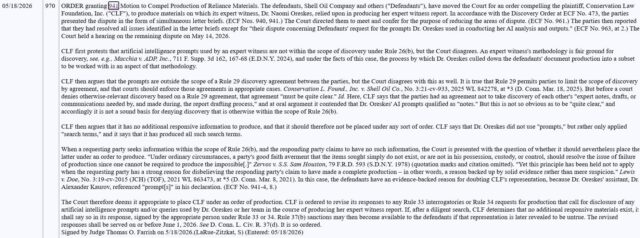
Why did the court rule this way? In part, because the prompts shaped how the expert sifted millions of documents down to a smaller set for analysis, the court saw them as no different from formulas, code, or other methodological steps experts must disclose.
The parties had limited discovery of “expert notes,” but the judge found it wasn’t “quite clear” that the label covered AI prompts. Therefore, ambiguity went to the requesting party. Moreover, there was already evidence in the record that prompts existed because a research assistant’s declaration referenced “prompts.” According to the court, this gave defendants a “solid reason” to doubt the plaintiff’s claim that only search terms—not prompts—were used.
Why does this even matter?
Employers who have to defend matters in court (meaning, most everyone) may have to rely on expert testimony at some point. Think wage-and-hour damages models, hiring-algorithm validation, or statistical disparate-impact analyses, for example. Those experts increasingly use AI to crunch data.
After this ruling, opposing counsel can plausibly demand the underlying prompts, logic, or model configuration files. That cuts two ways: it can expose sloppy work or, conversely, bolster a well-designed analysis. Either way, employers need to assume that AI inputs will be fair game in discovery.
Regular readers may recall my posts last fall on AI preservation and AI-specific discovery requests. Judge Farrish’s order puts a judicial stamp on both themes: AI artifacts are evidence, and courts will ask for them.
Practical takeaways for employers and their counsel
- Preserve what your experts (and maybe your own teams) feed into AI tools. Contract for that preservation up front and ensure your litigation hold notices cover AI prompts and chat histories.
- Vet expert methodologies for transparency. An expert who can’t reproduce or explain her prompts is a cross-examination waiting to happen.
- Address AI expressly in discovery or protective-order negotiations. If you intend to shield prompts, say so clearly and specifically; generic language on “drafts” or “notes” won’t suffice after this case.
- Train internal teams that AI inputs—just like emails—may turn up in court. Casual “let’s see what ChatGPT thinks” explorations about pending claims could be discoverable.
The bottom line AI is no longer a black box that sits outside discovery rules. Connecticut has now set the precedent: if an expert’s analysis relies on AI, expect to turn over the recipe, not just the dish. Employers should update their litigation playbooks accordingly.