Yesterday on Twitter, a Connecticut legislator posted this:

State Representative Matt Lesser, be careful what you ask for. But since you asked, here’s a

Having tackled the predictions in employment law on a federal level, what does the future hold for employers in Connecticut?

Besides a debate on Family & Medical Leave Insurance, there are a few things we’re likely to see.

1. New bills at the General Assembly: The first one comes courtesy of Mara Lee

A year ago, I called on the legislature to update its employment laws to reflect modern realities.  (It’s actually something I’ve done for a number of years, but who’s counting?)

One of the laws I highlighted restricted “telegraph” companies from distributing goods or messages in the overnight hours.  Because the telegraph no longer is

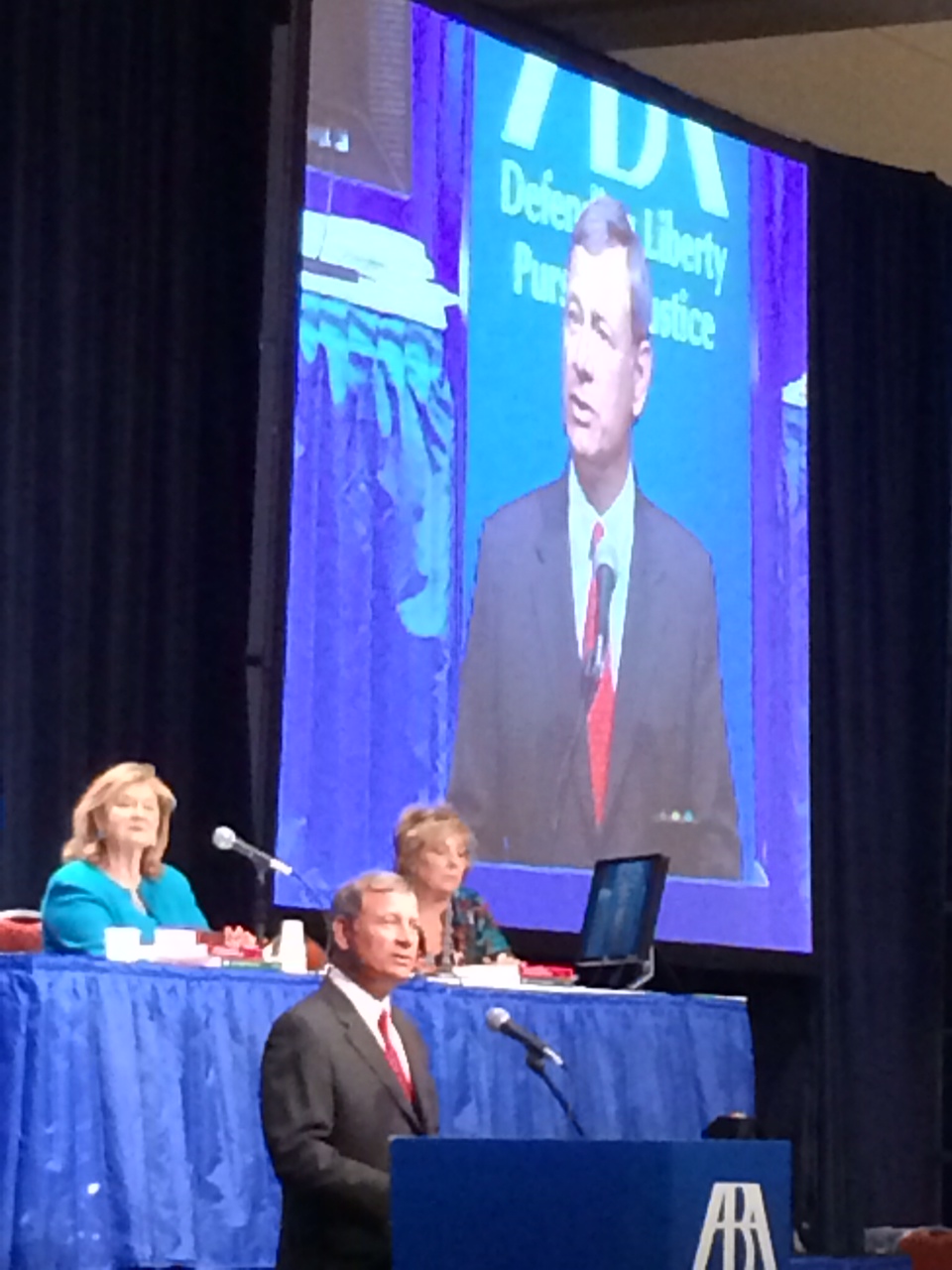
Chief Justice Roberts also addressed ABA to discuss the Magna Carta’s 800th anniversary

One of the roles that I relish is being a member of the American Bar Assocation’s House of Delegates for several terms now.   The ABA adopts certain policies at its Annual Meeting and uses its bully-pulpit to try

Last week, my colleagues Peter Murphy and Harrison Smith, offered to write about the latest developments in the law regarding pregnancy.  The post was scheduled to come out today, when, much to our surprise, the EEOC yesterday afternoon released long-awaited guidance on the subject.

So much for that post!

After a quick rewrite last night, here’s the very latest that includes both my comments and additional sourcing from Peter & Harrison….

Just a few short weeks ago, the U.S. Supreme Court announced that next term it will once again tackle an issue that raises strong feelings in many women (and men)–how pregnant women are treated in the workplace in comparison to non-pregnant employees. 

As anyone interested in employment law knows, both Congress and the EEOC have focused extensively in recent years on getting employers to provide reasonable accommodations to disabled employees.  Although what constitutes a reasonable accommodation remains a difficult determination in certain circumstances, the need to engage in an interactive dialogue with disabled employees over accommodations now is well established. 

What to do with pregnant employees under the Pregnancy Discrimination Act, however, has been less clear.  The EEOC yesterday chimed in with new guidance on the subject.

But let’s not get ahead of ourselves. First, the background.

The Federal Courts of Appeals are split on whether, and in what situations, an employer that provides work accommodations to non-pregnant, disabled employees with work limitations must also provide work accommodations to  pregnant employees who are “similar in their ability or inability to work” as the non-pregnant employees.  

In the case coming to the Supreme Court, Young v. United Parcel Service, the trial court and the Fourth Circuit held that the PDA does not require employers to provide accommodations to pregnant employees.  

The Fifth, Seventh and Eighth Circuits agree with the Fourth Circuit, while other courts, such as the Tenth Circuit and the Sixth Circuit, hold otherwise.

Since 2012, the EEOC has been kicking around the subject of revising its guidelines on the subject.  By a 3-2 vote, the EEOC decided that it could not wait until the Supreme Court gave birth to a clarifying decision, and so yesterday the EEOC issued its final pregnancy discrimination guidelines.
Continue Reading EEOC Declines a “Pregnant” Pause; New Guidance Awaits Supreme Court Decision

Collins, left, addresses CBA; Shipman & Goodwin Partner Gabe Jiran, right, moderates.

At Monday’s Connecticut Legal Conference, CHRO Chair Gary Collins spoke for a bit about the developments at the oft-maligned agency since he’s come on board.  (You can follow all the tweets from the conference on Twitter using #ctlegalconf as