
On Friday, I spent the morning at Quinnipiac University School of Law on a panel about employment and reasonable accommodation at the 14th John A. Speziale ADR Symposium by the Connecticut Bar Foundation. This year’s symposium focused on the ADA and the IDEA.
We covered a lot of law: essential functions, the interactive process, undue hardship, and a recent federal jury verdict involving a diabetes alert dog.
But the point I kept coming back to is a simple one.
Lawyers talk about accommodation in clinical terms. We talk about prongs, burdens, and “qualified individuals.” Underneath all of it, though, is a person who is trying to keep a job, and a manager who is trying to get the work done.
The process is about humans. The best employers never lose sight of that.
The Neighbor Test
“Reasonable” is one of those words that lawyers love and everyone else finds maddening. The ADA doesn’t give you a checklist. Whether an accommodation is reasonable, and whether it actually works, is often a fact question that courts are reluctant to decide on summary judgment.
So here’s the test I often use with clients: If I described this situation to my neighbor, would they think it’s fair?
Take the hypothetical our panel worked through. A Hartford nonprofit turns down an applicant’s request to bring a diabetic alert dog and offers six alternatives instead. That part may be fine. Employers can generally choose among effective accommodations.
But the nonprofit also ignores her offer of a 60-day trial. Then a CEO who never took part in any of the discussions withdraws the job offer after two weeks of silence.
Tell your neighbor that story. I doubt they’ll ask about undue hardship.
That’s also roughly what a jury in Virginia concluded last month in Torres v. Society for Human Resource Management. The jury found that SHRM failed to accommodate a job applicant with Type 1 diabetes who wanted to bring her alert dog, and it awarded $400,000 in compensatory damages. Notably, the jury also found that SHRM had engaged in the interactive process in good faith. A good process helps. It just isn’t enough if it doesn’t produce an accommodation that works.
An employee who asks to start an hour later because of medication side effects is asking for something most people would see as sensible. The EEOC has long used that type of schedule change as an example of a possible accommodation. An employee who demands a particular accommodation when an equally effective one is available is asking for something the law doesn’t require.
My thanks to the Connecticut Bar Foundation for putting on this program. The CBF has sponsored the Speziale Symposium since 1998. It’s named for former Chief Justice John A. Speziale, who was a pioneer in bringing ADR to Connecticut. Thanks also to moderator Kevin Barry and to my fellow panelists, Gary Phelan and Michelle Dumas Keuler.
A Keynote Worth Hearing
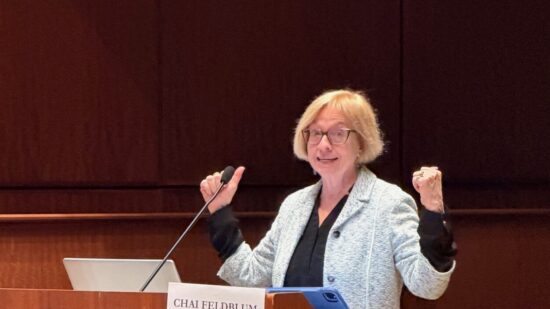
The highlight of the morning was the keynote from Chai Feldblum, and I’m grateful to her for a terrifically insightful talk.
Few people are better placed to talk about the ADA. She played a leading role in drafting and negotiating the ADA of 1990 and the ADA Amendments Act of 2008. She later served as an EEOC Commissioner from 2010 to 2019.
She traced the history and development of the statute, which was a useful reminder that much of the language we argue about today was the product of negotiation.
She also explained why an accommodation can be “reasonable” in general and still be an undue hardship for a particular employer. That distinction gets blurred all the time. Undue hardship is the employer’s burden, and it requires an individualized showing.
Finally, she said she still holds out hope that the concept of an “effective” accommodation could be written back into the law if the ADA is ever revised. In the Second Circuit, at least, the courts are already moving in that direction.
It’s not often you get to hear the history of a statute from one of the people who wrote it. Her current work with EEO Leaders is an example we could all learn from.
To watch the full symposium, see this link: http://ct-n.com/ctnplayer.asp?odID=27157